
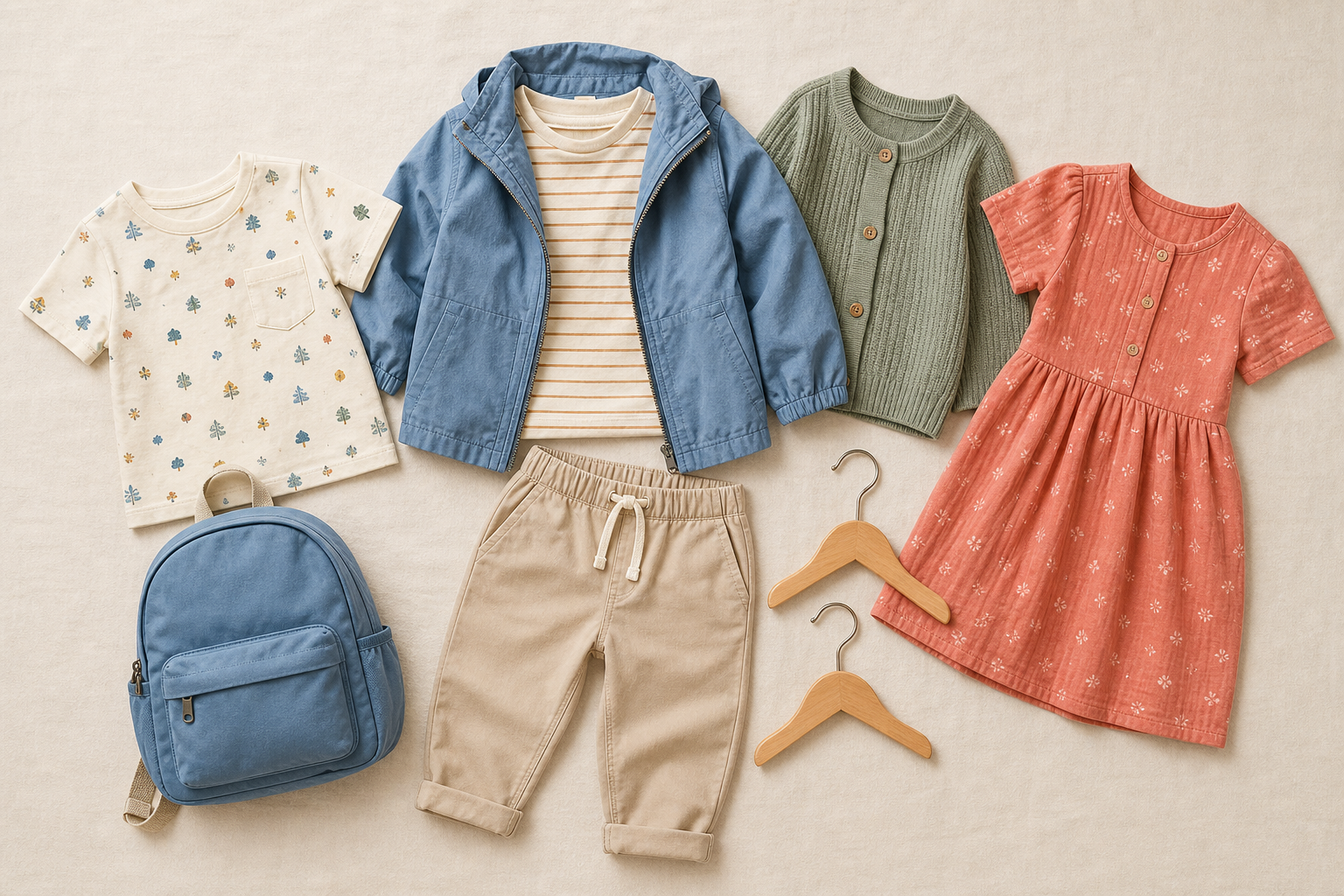
A practical back-to-school wardrobe can start with just 10 coordinated pieces: three everyday tops, two bottoms, one dress, two light layers, one weather-ready jacket, and one flexible extra chosen for your child's routine. The goal is not to make every child dress the same way. It is to create enough combinations for a school week while keeping fit, comfort, care, and changing weather easy to manage.
This 2026 checklist works whether school starts in August or September. Use it as a planning framework, then adjust the quantities for uniform rules, climate, laundry frequency, sports, sensory preferences, and how quickly your child is growing.
The 10-piece back-to-school capsule at a glance
| Piece | Quantity | Why it earns a place |
|---|---|---|
| Short-sleeve tops | 3 | Easy base layers for warm days and indoor classrooms |
| Everyday bottoms | 2 | Two neutral or coordinated options multiply outfits |
| Dress | 1 | A complete outfit with minimal morning decisions |
| Sweater or cardigan | 1 | Adds warmth without rebuilding the outfit |
| Sweatshirt | 1 | A casual layer for recess, travel, and activity days |
| Lightweight jacket | 1 | A commute layer; verify rain protection separately |
| Flexible extra | 1 | Use for another top, bottom, or occasion piece |
For this count, a two-piece matching set is two garments, not one. If you prefer a set to a dress, use the flexible-extra slot for its second piece; otherwise the total becomes eleven. A child who does not wear dresses can use that slot for another top or bottom.
Ten pieces do not mean only ten garments in the entire closet. Socks, underwear, sleepwear, shoes, uniforms, and activity-specific items sit outside this core. Think of the capsule as the reliable section of the wardrobe that can be mixed without a long search on a school morning.
Will ten pieces cover your laundry schedule?
Outfit combinations are not the same as clean outfits. Three tops plus a dress will not cover five fresh school-day outfits unless you wash midweek or choose a top as the flexible extra. Before shopping, count school days until clean laundry is ready again, then add any changes needed for sports or accidents.
- Midweek laundry: the core may work if cleaned pieces are dry and ready for the next morning.
- Weekend-only laundry: plan a clean base outfit for each school day. Add tops or bottoms beyond ten if your child needs fresh ones daily.
- A spare outfit kept at school: count that separately; it is not available for the home rotation.
Set out five complete outfits using clothes that already fit. A missing top on Thursday is a more useful shopping signal than an arbitrary capsule total.
Step 1: Begin with three dependable tops
Choose tops that work with both bottoms and underneath both layers. A simple rule is one quiet neutral, one favorite color, and one pattern. This creates variety without making every outfit dependent on a single matching piece. Short sleeves can continue into early fall beneath a sweater, which extends their useful season.
The Pattern T-shirt for Boys & Girls is one current example to compare for this base-layer role. Before ordering, check the live page for its current measurements, material details, available designs, delivery information, and return terms.
Step 2: Pick two bottoms that pass the movement test
School clothes need to handle sitting on the floor, climbing stairs, playground movement, and long stretches at a desk. Look for a secure waistband that does not pinch or slide, enough room through the seat and knees, and hems that do not drag. Ask the child to sit, squat, reach, and walk while trying on clothing. A standing mirror check alone can miss problems that appear during movement.
One plain bottom plus one playful option is usually easier to coordinate than two statement pieces. The Cartoon Children's Summer Pants can be evaluated as the lighter option in that pairing. Confirm the current size guide rather than buying only by age, because age labels are not a universal measurement standard.
Step 3: Add one complete outfit
A dress or coordinated outfit reduces decisions on busy mornings. It also adds visual variety to a capsule built mostly from separates. The best choice is still one the child can move in, manage independently when practical, and combine with an existing layer. For a dress, check whether the length and fabric suit playground activity and the school's dress expectations. For a set, make sure each half can also work with another piece.
Step 4: Use two layers for changing temperatures
Classrooms, buses, and outdoor play areas can feel very different on the same day. A sweater and a casual sweatshirt create two levels of warmth. The Cotton Warm Sweater for Boys & Girls is a current catalog option to assess for the warmer slot. Check the product page for exact fiber content and care information instead of relying on the title alone.
When selecting children's outerwear, inspect cords and closures as well as fit. The U.S. Consumer Product Safety Commission identifies hood and neck drawstrings on certain children's upper outerwear as an entanglement hazard and provides specific guidance for waist and bottom drawstrings. For school and playground use, a simple closure with no loose neck or hood cord is an important check.
Step 5: Reserve one jacket for the commute
The jacket should fit over the thickest planned school layer without restricting the shoulders. Test the zipper or buttons with the child, check sleeve length with arms extended, and confirm that a backpack can be worn comfortably over it. The Cotton-Padded Children's Jacket is one option to compare when cooler weather is approaching; verify current construction, sizing, and season suitability on the live listing.
How to check fit without guessing room to grow
- Use body measurements: compare height, chest, waist, and hip measurements with the specific product chart.
- Check the shoulder: the seam should sit in a workable position without pulling across the back.
- Test motion: have the child sit, bend, lift both arms, and walk.
- Inspect waistbands: they should stay up without leaving deep pressure marks.
- Leave practical growth room: a little ease is useful, but oversized hems, neck openings, or sleeves can interfere with movement.
If the product page provides garment measurements, compare them with a similar item that currently fits well. Lay the familiar garment flat and measure the same points. This often gives a more useful comparison than choosing the next age label automatically.
Make every piece earn its laundry space
Read the attached care label before washing a new garment. The U.S. Federal Trade Commission's Care Labeling Rule requires care instructions on covered garments and explains that the instructions should provide a regular-care method that can be followed without substantial harm to the item. Different fibers, trims, prints, and multi-piece outfits may require different treatment, so one universal laundry rule is not reliable.
Before the first school week, wash or prepare the clothing according to its label and confirm that every item still fits. Keep a separate basket for pieces needing stain treatment or repair. A capsule stops being useful when its only clean top is waiting for a missing button.
A five-day outfit rotation
- Monday: patterned top, plain bottom, lightweight jacket.
- Tuesday: neutral top, playful bottom, sweater.
- Wednesday: dress or matching set with the casual layer.
- Thursday: favorite-color top, plain bottom, sweater.
- Friday: use the flexible-extra top or an outfit cleaned and dried during the week.
Repeating a bottom or layer is part of the system, not a failure. The exact rotation depends on spills, weather, and activities. Photographing a few approved combinations can help older children dress independently and gives caregivers an easy reference.
Frequently asked questions
How many school outfits does a child need?
Five complete combinations are a useful starting point, but they do not require five separate head-to-toe outfits. A coordinated 10-piece capsule can create more than five combinations. Add backup quantities when laundry happens less often, uniforms are required, or the child regularly needs changes during the day.
Should I buy children's clothes one size larger?
Do not size up automatically. Compare the child's current measurements with the product's specific chart and test movement. Some growth ease can be helpful, but excessive length or a loose neckline can make an item uncomfortable and impractical.
What colors work best for a kids capsule wardrobe?
Choose two or three base colors already present in the child's closet, then add one favorite accent. Coordination matters more than choosing traditional neutrals. A bright capsule works when the tops, bottoms, and layers still share colors.
When should a back-to-school wardrobe be reviewed?
Review it before school starts, after the first few weeks, and again when the season changes. The early review catches fit or care problems; the later review shows which layers and replacements are genuinely needed.
Final checklist before ordering
Start with what already fits, list the actual gaps, and buy for real school routines rather than an imaginary perfect week. Confirm each product's current measurements, materials, care label, design details, availability, shipping, and return conditions. A smaller wardrobe succeeds when each piece is comfortable, compatible, and ready to wear.